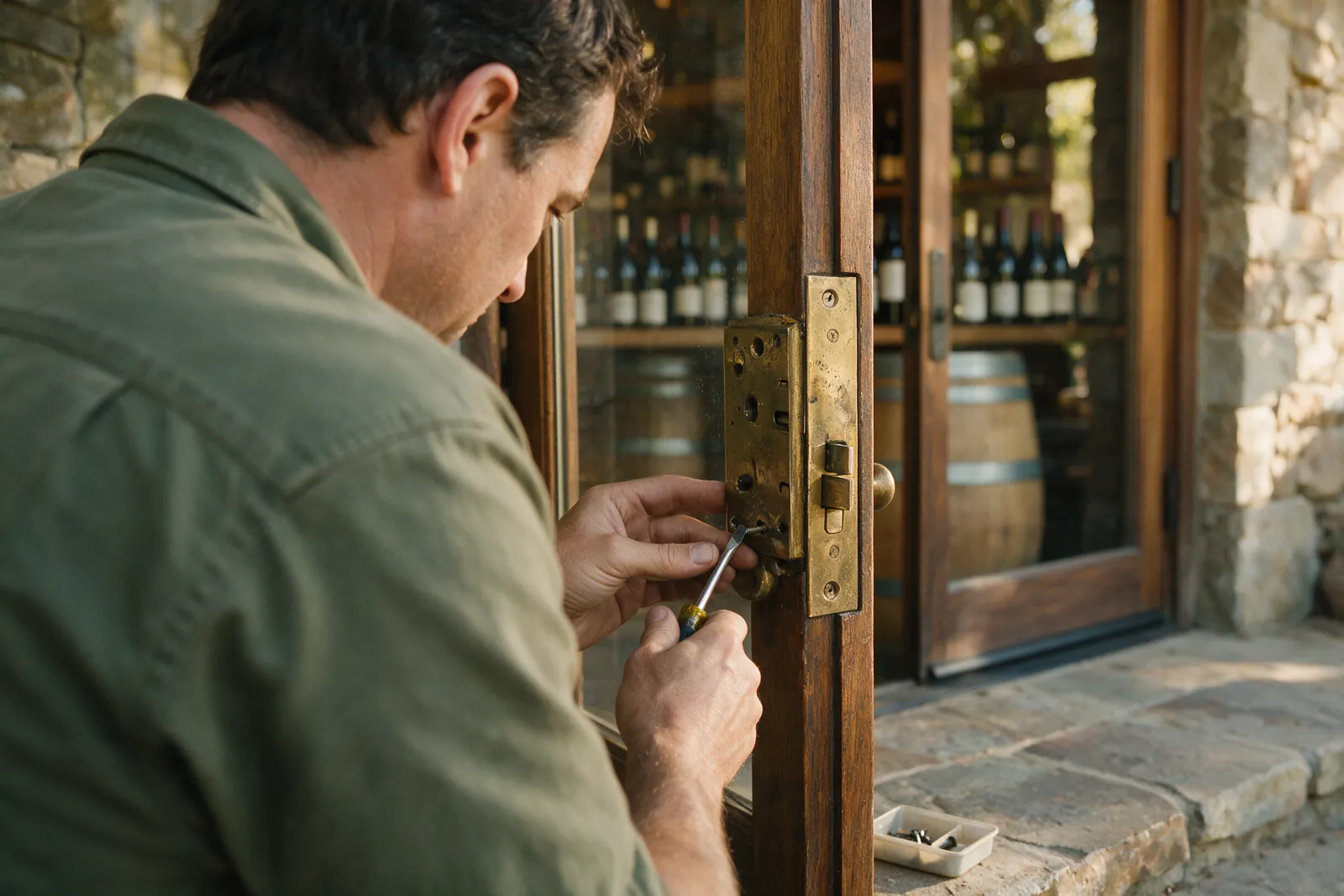
Three businesses behind one door
A tasting room in Healdsburg, Windsor or out along Old Redwood Hwy is three businesses in one building. The front is retail, with a glass door and a crowd of strangers all afternoon. The bar is licensed and has to close cleanly at a fixed hour. The back is a warehouse, with cased wine, a barrel room and sometimes a library of older vintages worth more than the register. Each of those spaces needs a different kind of lock, and most tasting rooms have grown into the building one door at a time without anyone thinking about all three at once.
The result is familiar. A front door cylinder that has been changed by three managers. A back door on a padlock. An office key that also opens the wine library because it was easier. None of it is dangerous on a Tuesday. It becomes a problem the day a seasonal hire leaves with a key ring, or the night the wind pushes the front door open because the latch never fully caught.
The front door: glass, wind and a thousand hands
Most tasting-room front doors are aluminum-framed glass, and the lock inside the stile is a commercial deadlatch or a hook bolt with a mortise cylinder. They fail in predictable ways. The latch drifts out of line with the strike as the door sags, so staff learn to lift the handle to lock it. The cylinder wears until any similar key wiggles it. The closer weakens and the afternoon wind off the valley floor holds the door a quarter inch open, which means the latch never engages and the alarm never arms.
Storefront and tasting-room door locks run $125–$395. That covers a new cylinder pinned to the key system, a fresh latch or hook bolt, and setting the strike so the door locks without a lift. The tech will also say whether the closer needs adjusting, since a door that does not shut cannot lock no matter what hardware is on it. Tolerance matters more on a glass door than on a house door; there is no wood to forgive a bad fit.
Exit devices the fire marshal will accept
A tasting room with a bar and a crowd is an assembly space, and the exits are governed by code. The side or rear door that staff use for cases needs to open from inside with one motion and no key, which means a panic bar or an exit device. Owners often discover this at an inspection, or after a visit from the fire marshal before a harvest event. A padlock on the inside of an exit door is the single most common violation in a winery building.
Panic bars and exit devices run $250–$690 installed, depending on whether the door needs a rim device, a vertical rod on a double door, or an alarmed device so staff cannot prop it. The right choice depends on the door, and it is worth having the tech look before you order anything online. A device that fits the door is quiet, closes flush and locks from outside on the same key system as the front. One that does not fit is a daily annoyance until someone disables it.
One key for the owner, one for the bar lead, none for the seasonal hire
The staff at a tasting room changes with the seasons. Harvest brings extra hands from August to October, wedding season brings weekend staff, and the bar lead who has been there four years should not have to lose access every time a part-timer is let go. A master key system solves this. The owner carries one key that opens everything. The bar lead carries a key that opens the front, the bar and the storage, but not the office. Seasonal staff carry a key that opens the front and nothing else, and when they leave, only that one cylinder needs attention.
Master key systems are quoted after a walk-through, never over the phone, because the price depends on how many doors, how many levels of access, and whether the existing cylinders can be pinned into the system or need replacing. The walk-through takes about half an hour and produces a diagram you keep. Done right, it is a system that lasts a decade with only small changes. Done wrong, it is a drawer of unlabeled keys.
Access control for the barrel room and the wine library
Some doors are better on a code or a fob than on a key. The wine library, where the older vintages live, is the obvious one: a keypad or reader logs who opened it and when, and a departed employee is removed with a keystroke rather than a rekey. The barrel room, which winemaking staff enter at odd hours during fermentation, is another. Access control is quoted after a site visit, since the answer depends on the doors, the wiring and whether the building already has a network to hang it on.
The honest advice is to put access control on two or three doors, not twenty. A keypad on the front door of a tasting room is a maintenance burden, since guests watch codes being entered and the pad wears in the sun. Keys for the front, a master system for staff, and readers on the doors that guard the money and the wine. That combination is what most Sonoma County tasting rooms actually need, and it costs a fraction of a full electronic system.
After-hours lockouts during harvest
Harvest is when tasting rooms get locked out. Staff are stretched, the closer runs a late private event, keys travel between the tasting room and the crush pad, and at 11 pm someone is standing at a glass door with a case of glasses and no way in. A business lockout runs $109–$199, plus $30 after 8 pm and $60 after midnight, and the total is sealed on the call. Calls are answered 24/7 through the season, and the name of the technician and the arrival window arrive by text before the van moves.
Non-destructive entry comes first on a commercial door, because drilling a mortise cylinder on a storefront means a replacement that same night. The tech carries the cylinders to do that if needed, but drilling only happens after you say yes and only at the quoted price. In most cases the door is opened, the lockout ends, and the conversation turns to why the key was on the crush pad in the first place.
Quick answers
Can the front door, the back door and the office all be on one key?+
Yes, and they should be for the owner. A master key system lets the owner carry one key while staff keys open only their own doors. It is quoted after a walk-through because the price depends on the number of doors and access levels.
Do I need a panic bar on a tasting-room exit?+
If the room is an assembly space with a bar and a crowd, the marked exits generally must open from inside with a single motion and no key. A panic bar or exit device runs $250–$690 installed. Confirm the specifics with your fire marshal.
What happens when a seasonal employee leaves with a key?+
In a master key system only the cylinders that key opened need to be repinned, usually the front door, at $19–$34 per cylinder. Without a system, every door that key fit has to be rekeyed, which is why the system pays for itself in a season or two.
Need it handled rather than read about?
(707) 324-5904More guides